Week One: Foraging in Long Eaton
- Gina Mollett
- Sep 28, 2025
- 3 min read

Foraging for oak galls, rosehips and hawthorn berries on the Autumn Equinox. Organising seeds and dried petals from flowers that I've grown this year at Long Eaton Community Garden. I've been reading about Autumn and how it is a time for change, transition and renewal. That one phase is ending whilst another is beginning. I'm thinking alot about the seasons and how I can create a seasonal palette of colour that can tell a story about the spirit of a place. Thinking about places that are sentimental to me across the East Midlands aswell as the places that are on my doorstep. I've been using the MAGIC map to find out where the sites of specific scientific interest are as foraging is not permitted in these areas.

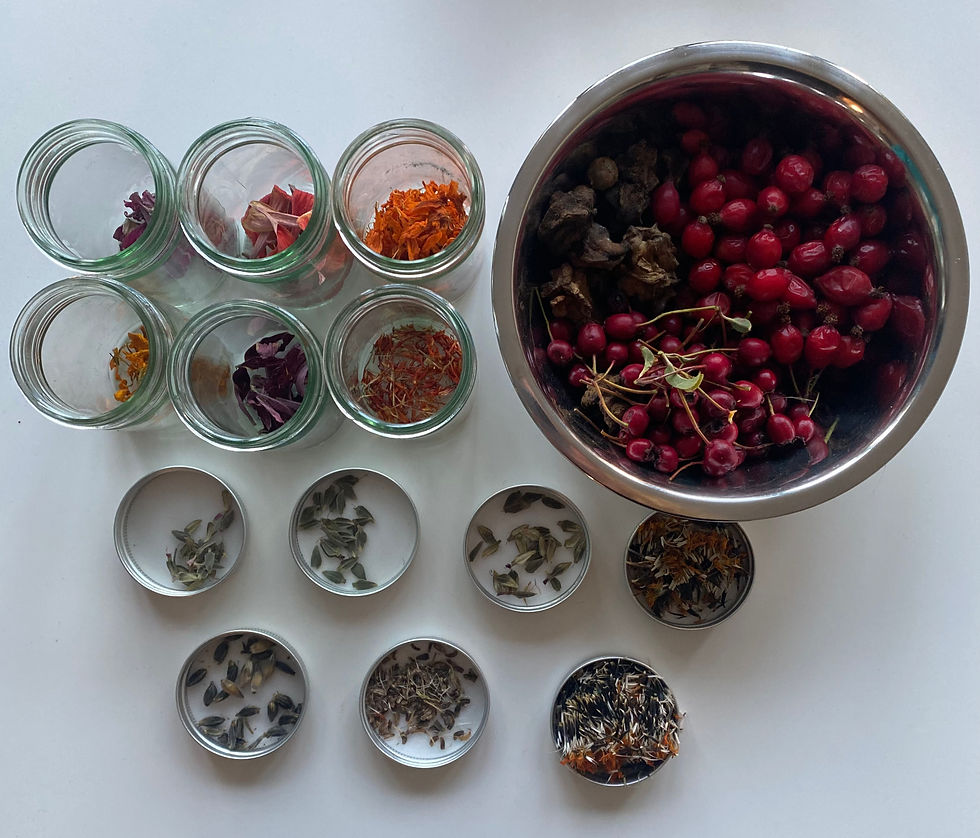
I have a couple of canvas bags that I take out with me on my foraging trips. There is something about foraging that brings back childhood memories of making potions and perfumes from natural materials. I feel excited as I forage and am grateful to nature for providing me with these gifts. It is so satisfying to bring the plant matter home and organise it into bowls, ramekins and recycled spice jars ready to be processed into natural colour. My desk is starting to look like a science laboratory as equipment and materials arrive ready for my natural dye experiments.

A Sunday morning walk foraging along the River Erewash. Collecting more oak galls, rosehips and hawthorn berries. Also acorns, sloe berries, lichens and basalt stone from the river bed. On the look out for herons and fish in the water. Thinking about how important it is to be ethical when foraging and to consider other wildlife that relies on nature's resources. I've learnt that the rule of thumb is to take only the amount that you need to create the natural dye, with a maximum of 10% of what is available. This walk is one of my favourites within my neighbourhood and I'm thinking about the beauty of visiting a local place on a regular basis as you are able to notice the subtle changes of the seasons.

I've been reading about the history of inks, the folklore associated with trees, and some interesting scientific facts on the plant matter that I have collected. A single oak may support around 200 species of organisms. Every part of it has been used in medicine at some point in time. Almost all surviving historical documents were likely to have been written with oak gall ink. Oak galls are odd-shaped growths that I have found attached to the acorns and stems of oak trees. They are caused by gall wasps and act as a womb for their larvae. It is best to pick them from the ground when they're brown so that you know that the larvae has matured and the wasp has left the gall. As I read about the oak as the king of the forest trees and its connections to the wizard Merlin and Robin Hood, I find myself questioning where I could find any links to the history of women. I will consider this as I move forward with this project and question how a natural ink may be able to tell a story that relates to the social history of women. I had hoped to collect oak galls from Bradgate Park in my hometown of Leicester to tell the story of Lady Jane Grey and the oak trees that were beheaded in mourning of her execution. But foraging is not permitted as it is a site of specific scientific interest. I'm curious to know what other stories can be uncovered through natural colour making.


