top of page

This week I completed the first stage of my Social & Therapeutic Horticulture course with Thrive. The benefits of gardening on our wellbeing is not a new concept. It was interesting to learn about the history of gardening for wellbeing and that this dates back to Ancient Egypt when royal physicians would prescribe a spell in the palace gardens for those of a troubled mind. From 1936 the use of horticulture became more recognised within Occupational Health as a specific treatment for physical and psychiatric disorders. As I am learning some of the theories behind gardening and why it is good for our physical and mental health, I am reflecting on my own experiences of volunteering at the Long Eaton Community Garden and how this has helped me to set goals, have something to nurture, and feel a sense of fascination and escape from everyday life. It has helped me to step away from thinking of things within the past and to focus on the current moment or make plans for the future. There are sensory elements that I enjoy too. Sticking my hands in the soil and listening to the sound of water sprinkling onto my plants. It has helped me to gain a sense of achievement and pride in watching plants grow from seed, and has tested my patience and problem solving skills when things have gone wrong. One thing that I've really enjoyed this year is collecting the flower heads to dry for natural colour making, and coming across all the seeds inside for next year!


Allotment
Allotment

As I continue with my studies into Social and Therapeutic Horticulture, I am excited to share that I have been offered an allotment plot after being on the waiting list for two years. The plot has been disused for some time and has become overgrown but I see the potential for what it could become. This will now provide an opportunity for me to scale up from my raised beds of approximately 10 plants at the Community Garden. As I don't have access to a garden at home, this will provide me with a green space to dwell in, look after and be creative with. Keep an eye on the Blog for updates on how the plot is being developed.

This week I've been learning more about Oak Galls. Princetown Press are running a course titled 'From Galls to Nettles' which focuses on natural colour making through the Autumn and Winter months. I'm blown away by the ethics that natural colour makers hold and that it is challenging me to be more considerate of the natural environment. The more I learn about Oak Galls, the more I am fascinated by them. Galls are protective 'wombs' found on oak trees. They occur when a wasp injects the oak tree with a wasp egg. For this reason it is important to only use Oak Galls that have an exit hole so that we know that the wasp has left and the gall is now empty. Iron Gall ink has been used for more than 2000 years. It is considered to be permanent and has been used for legal documents until recently.


Oak Galls
Oak Galls

I've also been up at the Heartwood Social Farming Centre as part of the 'Crafts in the Woods' sessions. The Heartwood Social Farming Centre is a beautiful regenerative farm that sits at the top of a hill in the Derbyshire Dales surrounded by woodland. I've been learning more about the history of the farm and its agroforestry plans for the future.


Heartwood Social Farming Centre

Woodland Walk
Woodland Walk

We took a walk to the through the woodland to search for different types of fungi which has got me thinking about how to make natural colour with mushrooms. We found a wide variety of fungi includng fly agaric, inkcaps, puffballs, blushers, horse's hoof and earthballs.

.


We arrived at the Forest School Camp ready for a brew sat around the fire. We spent the day learning about Flax that had been grown on the farm. Flax is used for its fibre to make linen textiles. First we took the seed heads off and threshed them with a rolling pin to get the seeds out. We winnowed the seeds with wind to separate them from the chaff. Then we worked with some retted flax to get the fibres, getting rid of the shiv and combing it into fibres that could be twisted into twine.


Flax
Flax
Flax Fibres Twisted into Twine

Whilst the process can be time consuming, it is helping me to reflect on slower processes that connect to the seasons, and the joint efforts of a community group that are working towards a common goal. It felt like we had a production line of flax in the forest and we questioned how differently this might look if it was on an industrial scale.


This week I have started a short course in Creative Health and Wellbeing through Artmaking at UAL, led by R.M. Sánchez-Camus. One of my favourite activities was mark making to music, and thinking about our associations to colour and line. I think alot about the type of materials that we use when making artworks and how these alone can be therapeutic, regardless of what the marks we make may look like.


Mark Making to Music

I've also started to read a couple of books to ground myself in some theory and best practice within Arts and Health. It has been interesting to read about the use of the arts within medical school teaching and how this can bring humanity to medical practice. Within my role as a Social Prescriber I am often working alongside clinical and non-clinical staff within Primary Care and I'm left questioning how the arts could be used not only to support their wellbeing but also to deepen their empathy and understanding of mental health conditions. I am also reflecting on my previous work within the arts and cultural sector and some of my favourite projects that have brought together students from the arts and the sciences. I wonder what might happen if we were to bring together art school and medical school students to explore the subject of Arts and Health? How might I approach the curation of an arts programme for medical students? How might the arts aid a person in their interactions with mental health services when they are struggling to find the words to describe their experiences? What would happen if a mental health nurse were to prescribe patients with a sketchbook and art materials to communicate their experiences?


"One domain that the arts may particularly nurture is the development of empathetic skills. Empathy has been shown to be of considerable importance in medical practice, for example to aid effective communication. Paintings, novels, film and drama can absorb us and bring us to tears of joy or sorrow. Such media facilitate entry into the worlds of others, to experience it and imagine it. Students with limited life experience can utilise the arts to imagine life from another's perspective." Victoria Tischler, Mental Health, Psychiatry and the Arts (2010)


Reading Material
Reading Material

I am reflecting on the structure of Arts and Health programmes, with a particular focus on how we approach beginnings and endings. I've always felt that relationships are key to any arts project. What can support a participant to make that initial mark on a piece of paper? What can support a participant to continue making those marks beyond the end of a project? I read that the climax of a project should not come at the very end, and that a project that sits with pain should not inflict any additional suffering. I'm thinking about the marks we make and how they are individual to us. What could the marks we make say about our unconscious minds?


"The wonderful beauty of the arts, in all forms, is that human emotion is involved in a raw and uncensored manner. Feelings flowing are essential for artistic experience. The professional artist and the inexperienced participant have in common the fact of being at their best as creators of visual imagery by their capacity to tap the unconscious and, as a result, to present in line, colour and form a mark that is individually their own, unable to be produced by any other individual in exactly the same way, ever." Roberta Nadeau, Using the Creative Arts in Therapy and Healthcare (2008)


Erewash Canal
Erewash Canal

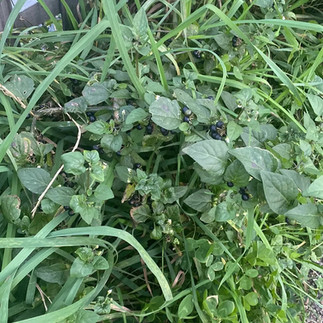
Whilst I've not been foraging this week, I have been walking along the Erewash Canal as the sun sets in the evening. As the moon has been rising in the sky I've been reflecting on the time of day and how this could impact the mood or feeling of a Creative Health workshop that connects to the cycles of nature. I've also been looking out for new things to forage and have been using the PictureThis plant ID app to discover the plant life that sits along the canal. Below are toxic berries that I will not be using!! Black nightshade, coralberry and jasmine. I've been learning about how important it is to ID plants before experimenting with natural colour as they could irritate the skin, have toxic fumes and be deadly poisonous.


bottom of page